
NATIONAL MARITIME HERITAGE COMPLEX: India’s relationship with the sea is as old as its civilization itself. With a vast coastline stretching over 11,098 kilometres, the country has been shaped for millennia by maritime trade, navigation, shipbuilding, and cultural exchange. From ancient dockyards and seafaring communities to global trade routes that connected India with Africa, the Middle East, Europe, and Southeast Asia, the Indian subcontinent has long been a central force in the maritime history of the world.
At the heart of this remarkable legacy lies Lothal, an ancient port city in Gujarat that offers the earliest known archaeological evidence of organised maritime activity dating back more than 5,000 years. Today, Lothal is once again set to reclaim its historic status on the global stage with the development of the NATIONAL MARITIME HERITAGE COMPLEX, a landmark initiative envisioned as India’s most ambitious cultural and maritime heritage project.
Planned near Ahmedabad and anchored in the timeless legacy of the Harappan civilisation, the NATIONAL MARITIME HERITAGE COMPLEX (NMHC) is designed to preserve, interpret, and showcase India’s maritime journey—from prehistoric times to the modern era. Once completed, it is expected to emerge as a world-class cultural destination, a hub for research and learning, and a symbol of India’s deep-rooted connection with the seas.
India’s Ancient Maritime Roots: A Civilisation Shaped by the Sea
India’s maritime story stretches far beyond recorded history. Archaeological findings, ancient texts, inscriptions, and foreign accounts collectively reveal that Indian sailors, traders, and shipbuilders mastered ocean navigation long before many other civilisations.
Evidence of maritime activity in India dates back nearly 5,000 years, placing the subcontinent among the earliest seafaring cultures in the world. The discovery of sophisticated dockyards, navigation techniques, and international trade goods highlights India’s role as a maritime powerhouse in antiquity.
Among all such discoveries, Lothal stands unparalleled.
Lothal: Home to the World’s Oldest Known Dockyard
Situated in present-day Gujarat, Lothal was one of the most prominent cities of the Harappan (Indus Valley) Civilisation, which flourished around 2400 BCE. Archaeological excavations at the site revealed what is widely recognised as the oldest known man-made dockyard in the world, built over 5,000 years ago.
This dockyard was not merely a local facility—it was a highly advanced maritime structure that connected Lothal to an extensive trade network. During that era, the region of Kachchh was part of the Arabian Sea, enabling seamless sea-based trade between Harappan cities in Sindh and the Saurashtra peninsula.
The dock’s design reflected remarkable engineering skill, including precise brickwork, water-control mechanisms, and tidal management systems. These features demonstrate that the Harappans possessed a deep understanding of marine geography, hydraulics, and ship movement—centuries ahead of their time.
Lothal as a Global Cultural and Commercial Hub
Lothal was not just a port—it was a thriving centre of economic exchange and cultural interaction. As traders arrived from distant lands, they brought more than goods. Along with beads, metals, textiles, and precious stones, they carried ideas, beliefs, artistic styles, and technological innovations.
This constant flow of people and knowledge transformed Lothal into a melting pot of cultures. Maritime trade routes enabled the exchange of languages, customs, religious practices, and scientific knowledge, making Lothal a key node in the ancient global economy.
It is this extraordinary blend of commerce, culture, and innovation that the NATIONAL MARITIME HERITAGE COMPLEX aims to bring back into public consciousness.
Vision Behind the NATIONAL MARITIME HERITAGE COMPLEX
Recognising the need to preserve and promote India’s unparalleled maritime history, the Ministry of Ports, Shipping and Waterways (MoPSW) conceptualised the NATIONAL MARITIME HERITAGE COMPLEX at Lothal, near Ahmedabad.
The project is envisioned as the first of its kind in India, dedicated exclusively to the country’s maritime legacy. It seeks to bridge the gap between ancient maritime achievements and modern naval and shipping advancements, presenting a continuous narrative of India’s oceanic journey.
The core objectives of the NATIONAL MARITIME HERITAGE COMPLEX include:
- Preserving and showcasing India’s maritime heritage across eras
- Establishing a globally recognised cultural and tourism destination
- Collaborating with India’s coastal states and Union Territories to represent regional maritime traditions
- Hosting international maritime fairs, exhibitions, and conferences
- Promoting international collaboration and exchange programmes
- Developing a centre for maritime education, training, and research
Through these goals, the NMHC aims to position India as a global leader in maritime heritage conservation and interpretation.
A Masterplan Rooted in Harappan Town Planning
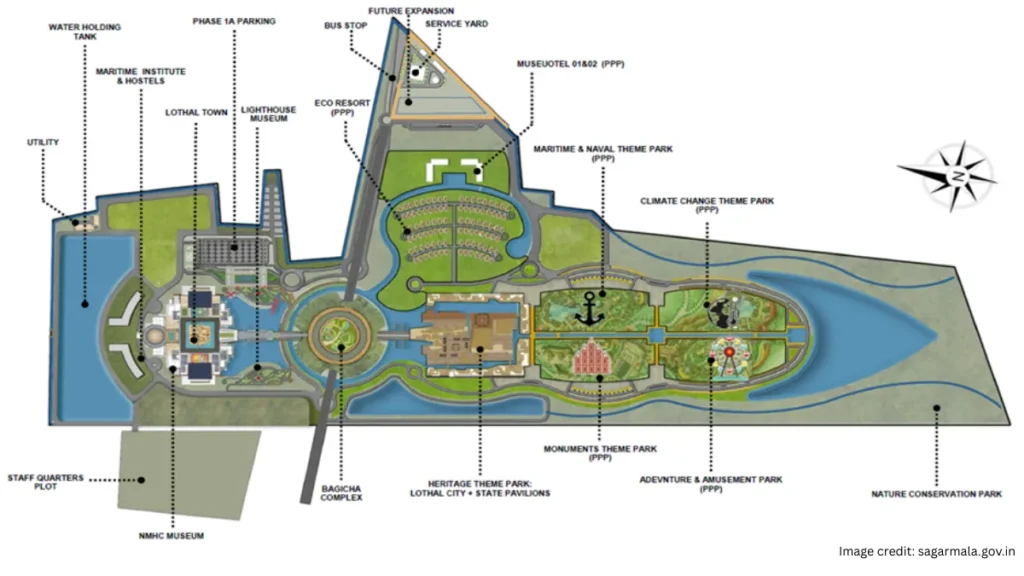
Spanning an expansive 375 acres, the masterplan of the NATIONAL MARITIME HERITAGE COMPLEX draws inspiration directly from Harappan town planning principles, known for their structured layout, zoning, and advanced civic planning.
The complex is divided into three major zones:
The Citadel: The Heart of the Complex
Located at the highest elevation of the site, the Citadel houses the most significant structures of the NMHC. In keeping with Harappan tradition, this elevated zone symbolises authority, knowledge, and cultural importance.
At the NATIONAL MARITIME HERITAGE COMPLEX, the Citadel is home to the National Maritime Museum, the flagship attraction of the entire project.
The Middle Town: Cultural and Social Core
The Middle Town features the Central Bagicha, a landscaped public space designed for gatherings, leisure, and cultural interaction. This area acts as a transitional zone, connecting the museum with recreational and educational facilities.
The Lower Town: Recreation and Hospitality
The Lower Town focuses on visitor experience and includes theme parks, eco-resorts, hotels, and a museotel. This zone ensures that NMHC functions not just as a museum, but as a vibrant, immersive destination suitable for families, researchers, and international tourists.
Phase-Wise Development of the NMHC
Given its scale and complexity, the NATIONAL MARITIME HERITAGE COMPLEX is being developed in a structured, phase-wise manner to ensure quality execution and long-term sustainability.
Phase 1A (EPC Mode)
Phase 1A forms the foundation of the project and includes core museum infrastructure and essential facilities. This phase is currently under advanced construction and is nearing completion.
Phase 1B (EPC Mode)
Phase 1B will expand museum spaces, galleries, and visitor amenities, building upon the assets created in Phase 1A.
Phase 2 (Land Sub-Leasing Model)
Phase 2 focuses on hospitality, recreational facilities, and commercial components through a land sub-leasing model, encouraging private participation while maintaining the heritage focus of the site.
Inside the National Maritime Museum: 14 Immersive Galleries
The National Maritime Museum at the NATIONAL MARITIME HERITAGE COMPLEX is designed as a journey through time, told across 14 meticulously curated galleries.
Gallery 1: Orientation and Oceanic Oral Traditions
An introduction to humanity’s relationship with the sea, featuring myths, legends, and oral histories tied to oceans and navigation.
Gallery 2: Harappans – The Pioneer Seafarers
A deep dive into Harappan maritime achievements, including Lothal’s dockyard, ship designs, and trade networks.
Gallery 3: Post-Harappan Trajectories
Explores how maritime traditions evolved after the decline of the Harappan civilisation.
Gallery 4: India’s Contact with the Greco-Roman World
Highlights India’s trade and cultural links with ancient Greece and Rome through maritime routes.
Gallery 5: Ancient India’s Maritime Heritage and Special Exhibitions
A dynamic space showcasing rotating exhibitions and rare artefacts.
Gallery 6: Evolution of the Indian Navy and Indian Coast Guard
Traces the growth of India’s naval forces from ancient times to the modern era.
Gallery 7: Trade and Cultural Relations with Southeast Asia and Beyond
Focuses on India’s maritime influence across Southeast Asia, East Asia, and the Indian Ocean region.
Gallery 8: Maritime Traditions of Gujarat
Celebrates Gujarat’s historic ports, shipbuilders, and trading communities.
Gallery 9: Age of Emporia Contact
Examines major ancient port cities and international trade hubs connected to India.
Gallery 10: Maratha Naval Power
Showcases the naval strength and maritime strategies of the Maratha Empire.
Gallery 11: Arrival of Europeans
Covers the entry of European trading powers and their impact on Indian maritime history.
Gallery 12: Science, Mathematics, and Technology
Highlights India’s contributions to navigation, astronomy, cartography, and shipbuilding science.
Gallery 13: Traditional Shipbuilding and Navigation Techniques
Features indigenous boat designs, tools, and navigational methods used across India.
Gallery 14: Indian Shipping Post-Independence
Chronicles the growth of India’s modern shipping industry after 1947.
Additional Attractions at the NATIONAL MARITIME HERITAGE COMPLEX
Beyond the museum, NMHC offers a wide range of attractions designed to engage visitors of all ages:
- Lighthouse Museum, showcasing the evolution of maritime navigation aids
- Bageecha Complex, offering landscaped recreational spaces
- An open aquatic gallery surrounding Lothal town, recreating the ancient port environment
- Coastal State Pavilions, representing the maritime heritage of India’s coastal states and Union Territories
- A recreated Lothal city, allowing visitors to experience Harappan urban life
- Four theme-based parks, blending education with entertainment
- Nature conservation parks, promoting environmental awareness and sustainability
Project Implementation and Current Progress
The NATIONAL MARITIME HERITAGE COMPLEX has been undertaken under the Sagarmala Programme, a flagship initiative of the Government of India aimed at port-led development.
The Government of Gujarat has played a crucial role by transferring 400 acres of land in Saragwala village to the Ministry of Ports, Shipping and Waterways on a 99-year lease, ensuring long-term project stability.
Renowned architect Hafeez Contractor has been appointed as the Principal Project Consultant, responsible for master planning and project management.
Construction of Phase 1A is being executed by Tata Projects Ltd and is currently in full swing. The phase is nearing completion and is scheduled to be finished by 2025, marking a major milestone in India’s cultural infrastructure development.
Read also: Lothal Maritime Museum: Exploring the Maritime Legacy of the Indus Valley Civilization
A Global Maritime Landmark in the Making
Once completed, the NATIONAL MARITIME HERITAGE COMPLEX is expected to stand among the world’s leading maritime museums and cultural destinations. By blending archaeology, architecture, technology, and storytelling, NMHC will offer an immersive experience that connects India’s ancient maritime past with its present and future.
More than a museum, the complex represents a national effort to reclaim and celebrate India’s identity as a maritime civilisation—one that shaped global trade, culture, and navigation for thousands of years.
As Lothal once again opens its gates to the world, the NATIONAL MARITIME HERITAGE COMPLEX promises to anchor India’s maritime legacy firmly on the global map.