
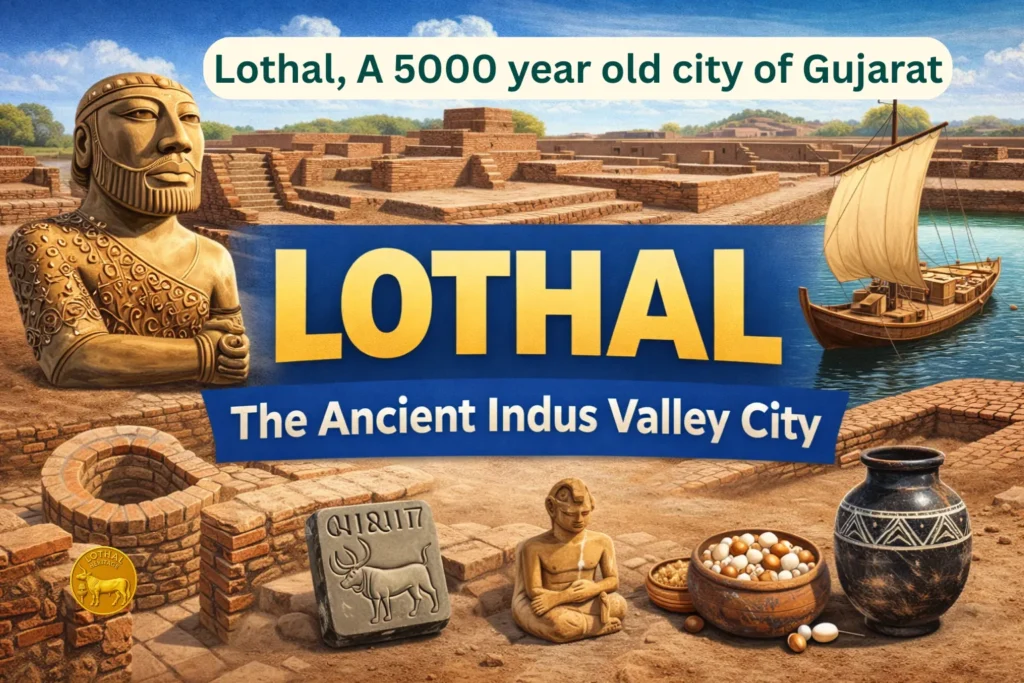
Lothal is one of the most remarkable archaeological sites in India and a powerful reminder of the country’s ancient maritime heritage. Located in the present-day state of Gujarat, Lothal was a prominent city of the Harappan or Indus Valley Civilization, which thrived between approximately 2500 BCE and 1900 BCE. Long before modern ports and trade networks existed, Lothal emerged as a strategically planned urban centre that connected the Indian subcontinent with distant lands through trade, craftsmanship, and innovation.
A Key City of the Harappan Civilization
During the height of the Indus Valley Civilization, Lothal played a crucial role as a commercial and industrial hub. Unlike many inland Harappan cities, Lothal was positioned close to the ancient course of the Sabarmati River and the Arabian Sea, giving it direct access to maritime trade routes. This strategic location allowed the city to develop into a flourishing port town that connected ancient India with regions such as Mesopotamia, Persia, and parts of the Middle East.
Archaeological evidence suggests that Lothal was deeply involved in the production and exchange of valuable goods. Artisans in the city were highly skilled in working with copper, bronze, semi-precious stones, shells, and ceramics. Finished products from Lothal were traded extensively, making the city an important contributor to the wider Harappan economy.

Discovery and Excavation by the Archaeological Survey of India
Although Lothal had remained buried for centuries, its significance came to light in the mid-20th century. Archaeologists from the Archaeological Survey of India (ASI) discovered the site in the early 1950s, followed by systematic excavations between 1955 and 1960. These excavations transformed the understanding of Harappan urban planning and maritime activity.
The ASI uncovered a well-organised city layout, marked by straight streets, carefully planned residential and industrial zones, and an advanced drainage system. The presence of covered drains, soak pits, and water management structures highlighted the Harappans’ deep understanding of sanitation and civic planning—features that were far ahead of their time.
The World’s Earliest Known Dockyard
The most iconic and widely discussed feature of Lothal is its massive dockyard. Considered one of the earliest known dockyards in the world, this structure provides clear evidence of the city’s role in marine trade. Built with baked bricks and designed with precision, the dockyard was connected to a river channel that allowed ships to enter during high tide.
Archaeologists believe the dockyard included slipways, loading platforms, and nearby warehouses where goods were stored before being shipped overseas. The design ensured that silt from the river did not clog the docking area, reflecting advanced engineering knowledge. This dockyard firmly establishes Lothal as one of the earliest centres of organised maritime commerce in human history.
Artefacts That Reveal Daily Life and Technology
Excavations at Lothal have yielded a wide range of artefacts that shed light on the daily lives, skills, and technologies of its inhabitants. Among the most notable discoveries are finely crafted beads made from carnelian, agate, and jasper. These beads were highly prized and traded far beyond the Indian subcontinent.
Seals bearing animal motifs and script symbols have also been found, indicating administrative systems and trade documentation. Tools and implements made from copper and bronze reflect advanced metallurgical practices. Pottery discovered at the site ranges from utilitarian storage vessels to decorative wares, showcasing both practicality and artistic expression.
In 2014, the ASI made another groundbreaking discovery at Lothal: a wooden plank estimated to be nearly 2,000 years old. This find is considered the oldest wooden object ever discovered in India. The plank provided valuable insight into ancient carpentry, construction methods, and the use of organic materials that rarely survive over millennia.
Decline and Abandonment of Lothal
Despite its prosperity and technological sophistication, Lothal eventually declined and was abandoned. The exact reasons for its downfall remain uncertain, but scholars believe a combination of natural and economic factors played a role. Changes in river courses, repeated flooding, silting of waterways, and shifts in trade routes may have gradually weakened the city’s economic foundations.
Additionally, the broader decline of the Indus Valley Civilization around 1900 BCE affected cities across the region. As trade networks collapsed and environmental challenges increased, urban centres like Lothal could no longer sustain their populations.
Ongoing Research and Historical Importance
The Archaeological Survey of India continues to study and preserve Lothal, recognising its immense historical value. Each new discovery adds to the understanding of ancient India’s global connections, technological capabilities, and urban planning traditions. Lothal stands as strong evidence that organised maritime trade and advanced civic systems existed thousands of years before similar developments in many other parts of the world.
Read also: Lothal History: The Rise, Brilliance, and Legacy of an Ancient Harappan Port City
How to Reach Lothal
Lothal is an archaeological site rather than a living city, and it does not offer hotels or accommodation facilities. The nearest major city is Ahmedabad, located approximately 50 kilometres away. Ahmedabad is well-connected by air, rail, and road, making it the most convenient base for visitors planning to explore Lothal.
From Ahmedabad, Lothal can be reached by car or taxi in about one to one and a half hours. Ahmedabad offers a wide range of hotels, guest houses, and budget accommodations suitable for all travellers. It is advisable to book accommodation in advance, especially during peak tourist seasons, to ensure availability and better pricing.
Read also: What happened to Lothal? Tracing the Rise and Decline of an Ancient Port City
A Window Into India’s Ancient Maritime Legacy
Lothal is far more than an archaeological site—it is a window into an era when India stood at the centre of early global trade. Its dockyard, drainage systems, artefacts, and urban design continue to fascinate historians, archaeologists, and visitors alike. As research continues, Lothal remains a powerful symbol of ancient innovation, resilience, and the enduring legacy of the Harappan civilization.