
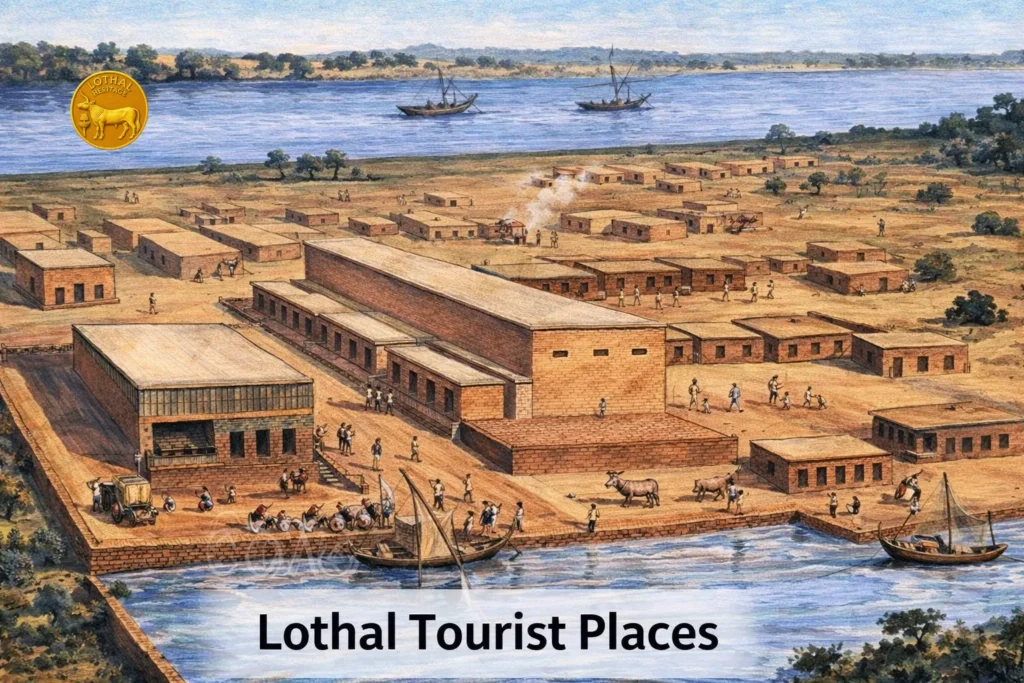
Lothal tourist places attract history lovers, students, travelers, and culture enthusiasts from across India and the world. Lothal is one of the most important archaeological sites of the Indus Valley Civilization, located in the Ahmedabad district of Gujarat. This ancient port city tells the story of advanced urban planning, maritime trade, and scientific knowledge that existed more than 4,000 years ago. Visiting Lothal is not just a trip, but a journey into India’s glorious past.
Introduction to Lothal and Its Historical Importance
Lothal was discovered in 1954 and is believed to have been a thriving port city of the Harappan civilization around 2400 BCE. It played a key role in trade between India and other ancient civilizations like Mesopotamia. The town was carefully planned, with well-built streets, drainage systems, warehouses, and docks. Today, Lothal tourist places help visitors understand how advanced life was during that period.
Lothal Archaeological Site
The Lothal Archaeological Site is the main attraction and the heart of all Lothal tourist places. Spread over a large area, this site contains the remains of houses, streets, workshops, and public structures. Walking through the ruins gives a clear idea of how the ancient city was organized.
The city was divided into a citadel and a lower town. The citadel was built on a raised platform to protect it from floods and was likely used for administrative and religious purposes. The lower town was where common people lived and worked. The use of baked bricks and straight roads shows careful planning and engineering skills.

The Great Dockyard of Lothal,A Marvel of Ancient Engineering
The dockyard is one of the most fascinating Lothal tourist places and is considered the earliest known dock in the world. It was built to connect the city with the nearby river and the Arabian Sea, allowing ships to anchor safely. The dockyard shows that the people of Lothal were skilled in maritime activities and international trade.
The structure was designed to manage water levels during tides, which reflects deep scientific understanding. Traders used this dock to export beads, ornaments, pottery, and other goods. Standing near the dockyard, visitors can imagine ships arriving from distant lands thousands of years ago.
The Warehouse of Lothal,Center of Trade and Storage
The warehouse is another important highlight among Lothal tourist places. It was used to store goods before export. The warehouse was built on a high platform to protect it from floods, and it had multiple square blocks for storing items.
The strategic location of the warehouse near the dockyard shows how trade activities were carefully planned. This structure proves that Lothal was a major trading hub of its time and played an important role in the economic system of the Indus Valley Civilization.
The Drainage System and Urban Planning
One of the most impressive aspects of Lothal tourist places is the advanced drainage system. The city had covered drains made of bricks, which carried waste away from houses and streets. This level of sanitation was far ahead of its time and shows the importance given to public health.
The streets were laid out in a grid pattern, intersecting at right angles. Houses were built with uniform bricks and had bathrooms and wells. This thoughtful planning makes Lothal a perfect example of early urban development.
Lothal Museum

Understanding the Past Through Artifacts
The Lothal Museum is an essential stop when exploring Lothal tourist places. It houses a rich collection of artifacts found during excavations. These include tools, pottery, seals, beads, jewelry, toys, and figurines.
One of the most interesting exhibits is the Persian Gulf seal, which proves trade connections with other civilizations. The museum also displays ancient weights and measures, showing that trade was based on standardized systems. The museum helps visitors connect the ruins with real objects used by people thousands of years ago.
Bead Factory and Craftsmanship Area,Excellence in Art and Skill
Lothal was famous for its bead-making industry, and the remains of bead factories are among the notable Lothal tourist places. Archaeologists found evidence of workshops where beads made from semi-precious stones like carnelian and agate were produced.
The quality and finish of these beads show high levels of craftsmanship. These beads were exported to different parts of the ancient world, making Lothal an important center for luxury goods.
Fire Altars and Religious Beliefs
Some structures at Lothal are believed to be fire altars, indicating religious practices related to fire worship. These sites are quiet but meaningful Lothal tourist places for those interested in ancient beliefs and rituals.
The presence of these altars suggests that religious activities were an important part of daily life. It also helps historians understand the spiritual culture of the Harappan people.
Lothal as a Scientific Hub,Astronomy and Measurement
Among Lothal tourist places, the evidence of scientific knowledge stands out strongly. Archaeologists discovered a circular structure believed to be used for astronomical observations. This suggests that the people of Lothal studied the movement of stars and planets.
Standardized weights made from stone also show accurate measurement systems. These scientific achievements highlight the intellectual strength of the ancient civilization that lived in Lothal.
Nearby Attractions Around Lothal,Village Life and Natural Surroundings
Apart from the main site, the surrounding villages offer a peaceful rural experience. Visitors can observe traditional Gujarati village life, farmlands, and local culture. These nearby areas add charm to Lothal tourist places and make the trip more relaxing and meaningful.
The open landscape around Lothal also provides a calm environment, ideal for slow exploration and photography.
Best Time to Visit Lothal Tourist Places
The best time to visit Lothal tourist places is between October and March. During these months, the weather is pleasant and suitable for walking around the archaeological site. Summers can be very hot, while monsoons may make the area muddy and uncomfortable.
Early morning or late afternoon visits are recommended to avoid strong sunlight and to enjoy the site peacefully.
How to Reach Lothal
Lothal is located about 80 kilometers from Ahmedabad. It is well connected by road, and visitors can easily reach by car, taxi, or bus. Ahmedabad railway station and airport are the nearest major transport hubs.
A day trip from Ahmedabad is common, but history lovers may prefer to spend more time exploring all Lothal tourist places in detail.
Entry Fees and Visiting Hours
The Lothal Archaeological Site and museum are managed by the Archaeological Survey of India. The entry fee is minimal, making it affordable for all visitors. The site is usually open from morning to evening, but timings may vary on holidays.
It is advisable to check the latest visiting hours before planning your trip.
Tips for Visiting Lothal Tourist Places
Wearing comfortable shoes is important, as the site requires a lot of walking. Carry water, sunscreen, and a hat, especially during warmer months. Reading about Lothal’s history before visiting can make the experience more enjoyable and informative.
Photography is allowed in most areas, but visitors should respect the site and avoid touching or damaging the ruins.
Educational Importance of Lothal
Lothal tourist places are highly educational, especially for students and researchers. Schools and colleges often organize trips to Lothal to help students understand ancient Indian history in a practical way.
The site provides real-life examples of topics like urban planning, trade, science, and culture, making learning more interesting and memorable.
Read also: Lothal Museum Timings: Entry Hours, Best Visiting Time, and Travel Tips
Lothal in Modern Tourism
Today, Lothal is gaining recognition as an important heritage tourism destination. Efforts are being made to improve facilities, signage, and visitor services. With better promotion, Lothal tourist places have the potential to attract more national and international tourists.
The site also reminds modern society of the importance of sustainable living, planning, and respect for nature.
Why Lothal Tourist Places Are Worth Visiting
Lothal tourist places offer a rare opportunity to see one of the world’s oldest port cities. The combination of history, science, trade, and culture makes Lothal unique. It is a place where the past speaks clearly through bricks, streets, and structures.
For anyone interested in India’s ancient heritage, Lothal is not just a destination but an experience that leaves a lasting impression.
Read also: India and the Netherlands Sign Historic MoU to Develop National Maritime Heritage Complex at Lothal
Conclusion
Lothal tourist places stand as a proud symbol of India’s ancient wisdom and achievements. From the world’s earliest dockyard to advanced urban planning and international trade, Lothal showcases a civilization far ahead of its time. Visiting Lothal helps us understand where we come from and inspires respect for our rich cultural roots.
A trip to Lothal is both educational and inspiring, making it one of Gujarat’s most valuable historical treasures and a must-visit destination for every curious traveler.