
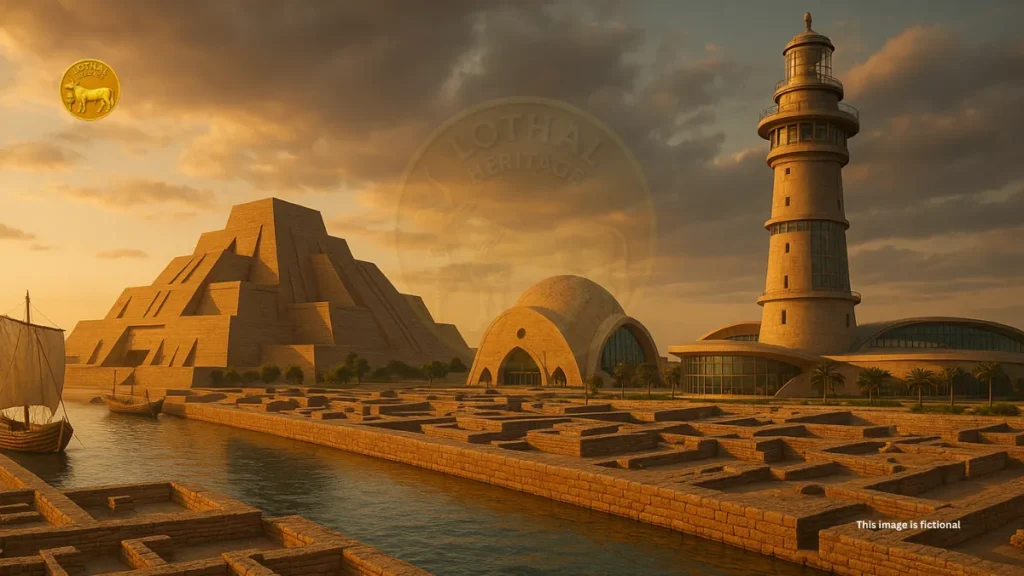
Lothal UNESCO World Heritage Site: Around 80 kilometres southwest of Ahmedabad lies Lothal, a remarkable archaeological treasure that continues to reshape global understanding of early urban and maritime civilizations. Today, this quiet landscape in Gujarat stands as one of the most significant remnants of the Indus Valley Civilization, a sophisticated society that flourished more than 4,500 years ago across regions that are now part of India and Pakistan. As discussions progress about granting the site the prestigious status of a Lothal UNESCO World Heritage Site, historians, travellers, and researchers are once again turning their attention to this ancient port city.

A Glimpse Into a 4,500-Year-Old Urban Marvel
When archaeologists first began excavating Lothal, they uncovered evidence of extraordinary planning and engineering abilities. The site revealed what many scholars consider to be the earliest known artificial dockyard in the world-a pioneering structure that speaks volumes about the maritime ambition of the Indus Valley people. The dockyard, which once connected to an extinct channel of the Sabarmati River, demonstrates how the region’s inhabitants created a thriving port that linked them to distant cultures and trade routes.
Even today, visitors can clearly identify several key features of the ancient settlement: the sophisticated drainage system, the well-planned lower town, an industrial-scale bead factory, and large brick warehouses. These discoveries reflect an organized community that understood commerce, craftsmanship, and urban design long before similar advancements appeared in many other parts of the world.
Because of its archaeological importance, India has put forward Lothal as a nominee to become a Lothal UNESCO World Heritage Site, highlighting its global cultural value. It remains one of the most frequently visited historical attractions for travellers exploring Ahmedabad and surrounding regions.
A Hub of International Trade
Excavations at Lothal have uncovered artefacts that illustrate the settlement’s far-reaching commercial network. Items such as seals, beads, pottery, and metal tools indicate that the port likely engaged in active trade with ancient civilizations including Mesopotamia, Persia, and Egypt. The presence of beautifully crafted beads—many made from carnelian-suggests that the settlement was an industrial hub exporting luxury goods across maritime routes.
Archaeologists believe that the city once supported a vibrant trade economy, with canals and dock facilities designed to accommodate ships arriving from the Gulf of Cambay. This system enabled the transport of goods such as gems, shells, ivory, and copper. The sophisticated urban layout demonstrates the ability of the Indus Valley Civilization to integrate industry, commerce, and residential life in an efficient and well-planned manner.
Over time, the region surrounding the ancient port developed into a settlement complete with markets, workshops, and living quarters-creating a complex ecosystem that would have sustained thousands of people.
Rediscovery in the 20th Century
Although Lothal flourished thousands of years ago, its existence was forgotten until the mid-20th century. In 1950, a team of archaeologists surveying the Sabarmati River basin came across several sites believed to be associated with the broader Harappan network. Their discoveries challenged earlier assumptions that the Indus Valley Civilization was confined mainly to areas of present-day Pakistan, northeast Afghanistan, and segments of northwest India.
Lothal soon proved to be one of the most significant findings. Its strategic location between the Bhogavo River and the Sabarmati River made it a natural centre for trade and maritime activity. Historical evidence suggests that during its peak, ships could sail directly from the Gulf of Cambay to Lothal during high tide. Over the centuries, geological changes pushed the sea more than 19 kilometres away from the site, altering the landscape but preserving many of its secrets.
From 1955 to 1962, a full-scale excavation project was carried out, lasting nearly seven years. The extensive work uncovered a rich collection of artefacts, structures, and tools that continue to be studied today. To preserve these findings and provide a window into ancient life, a dedicated museum was established at the site in 1976. This museum has since become an essential centre for understanding the Indus Valley Civilization and its trade relations with Mesopotamia and other advanced societies of the ancient world.
What Makes Lothal Famous?
Lothal’s global recognition stems from its unique combination of maritime infrastructure, industrial facilities, and well-organized urban planning. It is one of the few archaeological sites from the Indus Valley Civilization that provides direct evidence of dockyards and overseas trade. The bead-making workshops discovered here were among the most sophisticated in the ancient world, producing goods that travelled across continents.
For students of history, travellers, researchers, and cultural enthusiasts, Lothal offers a rare opportunity to walk through a city that thrived thousands of years ago yet still showcases the ingenuity of its people. It frequently features in tourism itineraries across Gujarat and remains a vital stop for anyone seeking to understand the roots of India’s early cultures.
Lothal’s Place in Modern Gujarat
Yes, Lothal is indeed located in Gujarat, India. Positioned in the Ahmedabad district, the ancient port sits along the Bhogavo River, a right-branch tributary of the Sabarmati. Its geographical position made it an ideal maritime gateway during the Indus Valley period.
Today, the site is accessible by road from Ahmedabad and is maintained as a protected archaeological area. Visitors can explore the excavated ruins, walk through the dockyard space, and learn about the city’s industries through museum exhibits. Government initiatives have also proposed new heritage and tourism developments in the region to enhance visitor accessibility and historical education.
Also read: Town Planning of Harappan Civilization: A Remarkable Legacy of Urban Vision
Why Lothal Deserves UNESCO World Heritage Status
As conversations continue about designating the site as a Lothal UNESCO World Heritage Site, experts argue that the settlement stands as one of the world’s earliest examples of urban maritime planning. Its dockyard predates many other known ancient ports, and its artefacts reveal a level of international trade that was highly advanced for its time.
Recognizing Lothal as a World Heritage Site would not only safeguard its extraordinary legacy but also highlight India’s contributions to early global commerce, engineering, and city planning. For the international community, it would serve as a reminder that ancient civilizations across South Asia played a vital role in shaping the foundations of modern society.