
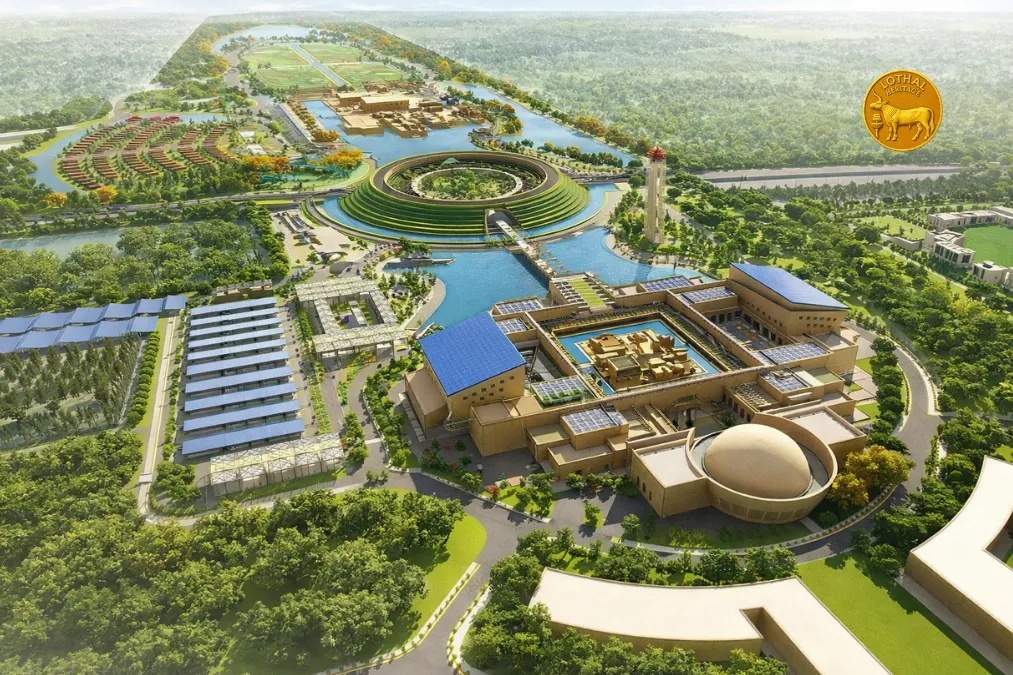
Port Blair, India: National Maritime Heritage Complex Lothal: The Andaman and Nicobar Administration has issued a public appeal inviting citizens, historians, researchers, artists, and collectors to contribute valuable materials and historical information for the Union Territory’s pavilion at the upcoming National Maritime Heritage Complex Lothal in Gujarat.
The initiative marks a significant step in ensuring that the rich maritime history and cultural identity of the Andaman and Nicobar Islands are prominently showcased at what is set to become India’s largest maritime heritage project.
A Landmark National Project in Gujarat
The National Maritime Heritage Complex Lothal is being developed by the Government of India at the historic site of Lothal in Gujarat — one of the world’s oldest known dockyards, dating back to the Indus Valley Civilization. The project is part of the ambitious Sagarmala Programme spearheaded by the Ministry of Ports, Shipping and Waterways (MoPSW), which aims to modernize India’s maritime infrastructure while celebrating its centuries-old seafaring legacy.
Designed as a world-class heritage destination, the complex will highlight India’s deep-rooted maritime traditions, naval history, coastal trade routes, shipbuilding evolution, and cultural exchanges with global civilizations. Once completed, it is expected to attract international tourists, maritime scholars, and history enthusiasts from across the UK, US, Europe, and Asia.
Dedicated Pavilion for Every State and Union Territory
A key feature of the National Maritime Heritage Complex Lothal will be the creation of individual pavilions representing each Indian state and Union Territory. These pavilions are intended to reflect the distinct architecture, maritime history, lifestyle, and cultural heritage of the respective regions.
In this context, the Andaman and Nicobar Administration has reaffirmed its commitment to developing a visually compelling and historically authentic Coastal Union Territory Pavilion. The pavilion will focus on presenting the Islands’ unique maritime narrative — one shaped by geography, indigenous traditions, colonial history, naval significance, and thriving coastal communities.
Officials stated that public participation is essential to ensure that the pavilion truly represents the spirit and legacy of the Islands.
Call for Artefacts, Historical Records, and Cultural Inputs
To enrich the content of the pavilion at the National Maritime Heritage Complex Lothal, the Administration has invited residents and institutions to share relevant materials and documentation connected to the Islands’ maritime past.
The requested contributions include:
- Information on coastal archaeological sites and historic port settlements
- Artefacts and antiquities such as sculptures, terracotta objects, figurines, coins, paintings, and manuscripts reflecting maritime traditions
- Details of monuments, temples, forts, cave sites, sculptures, and inscriptions related to coastal heritage
- Documentation of historical trade routes and cultural exchanges with foreign nations
In addition, the Administration is seeking inputs on traditional boat-building and shipbuilding practices that have been passed down through generations in the Islands. The Andaman and Nicobar region has long played a strategic role in maritime navigation in the Bay of Bengal, making its historical contributions particularly significant.
Showcasing Living Maritime Traditions
Beyond archaeological and historical records, the pavilion at the National Maritime Heritage Complex Lothal aims to highlight the living cultural traditions of coastal communities in the Islands.
Authorities have encouraged submissions related to:
- Indigenous and coastal community lifestyles
- Maritime folklore and oral histories
- Festivals linked to the sea
- Traditional fishing techniques
- Continuity of art and craft traditions such as bead-making, pottery, textiles, and metalwork
Replicas and models that depict historic forts, ancient ships, coastline activities, traditional cuisine, and maritime celebrations may also be considered for display.
Officials emphasized that the pavilion will not merely present static artefacts but will tell a compelling story of resilience, adaptation, and maritime excellence that defines the Andaman and Nicobar Islands.
A Platform for National and Global Recognition
The National Maritime Heritage Complex Lothal is expected to become a major cultural landmark, offering immersive exhibitions, research facilities, and educational programs. With global tourism in focus, the complex is likely to draw significant attention from international visitors, particularly from maritime nations such as the United Kingdom and the United States, where interest in naval history and seafaring heritage remains strong.
By participating in this initiative, residents of the Andaman and Nicobar Islands have a unique opportunity to place their maritime legacy on a national and global platform.
The Administration has assured that all meaningful contributions will be duly acknowledged in the A&N Pavilion at the complex. Contributors whose artefacts or information are selected for display will receive official recognition.
How to Submit Contributions
Individuals, researchers, institutions, and cultural organizations wishing to contribute can submit their materials and documentation to the Secretary (Art & Culture), Andaman and Nicobar Administration.
Submissions can be made via email at artand.culture@and.nic.in or delivered directly to the office of the Art & Culture Department.
The Administration has encouraged early submissions to allow sufficient time for evaluation, documentation, and curation before the completion of the pavilion.
Also read: Lothal Excavation 2025–2026: Gold Particles Discovered as Archaeologists Resume Dig After 65 Years
Strengthening India’s Maritime Identity
The development of the National Maritime Heritage Complex Lothal underscores India’s renewed focus on its maritime roots. Historically, India’s coastline has served as a gateway for trade, cultural exchange, and naval strategy. From ancient dockyards and spice routes to modern shipping corridors, the nation’s connection with the sea has shaped its economic and cultural evolution.
For the Andaman and Nicobar Islands, this initiative represents more than just participation in a national exhibition — it is an opportunity to celebrate a legacy deeply intertwined with the ocean.
By inviting public contributions, the Administration has taken an inclusive approach to ensure that the pavilion authentically captures the Islands’ story. Residents are now being called upon to play their part in preserving and presenting this heritage.
As preparations move forward, the Andaman and Nicobar Administration has expressed confidence that enthusiastic community participation will help create a pavilion that stands out within the National Maritime Heritage Complex Lothala proud representation of the Islands’ vibrant maritime history on the national stage.