
An in-depth report on one of the Indus Valley Civilisation’s most remarkable archaeological discoveries
The Harappan port city Lothal, situated along the dried course of the Bhogava River-once a vibrant tributary of the Sabarmati in the Gulf of Khambhat—stands today as one of the most extraordinary archaeological testaments to early urban planning, maritime trade, and technological innovation. Spanning approximately seven hectares, this ancient settlement reflects the complexity and sophistication of the Indus Valley Civilisation, one of the world’s earliest urban cultures.
Lothal’s massive peripheral walls, ranging from 12 to 21 metres in thickness, were engineered to withstand recurring tidal floods that shaped life in this coastal region. Ironically, these very floods that the residents prepared for with such ingenuity are believed to have played a major role in the city’s eventual decline. Yet the resilience and architectural intelligence visible in Lothal’s ruins offer an unparalleled window into the maritime ambitions and cultural dynamism of the Harappans between 2400 BCE and 1600 BCE.
This report explores the historical significance, archaeological discoveries, urban layout, and global relevance of Lothal, widely recognised as the only fully excavated Harappan port town and home to the world’s earliest known tidal dockyard.
A Meticulously Planned Harappan Metropolis
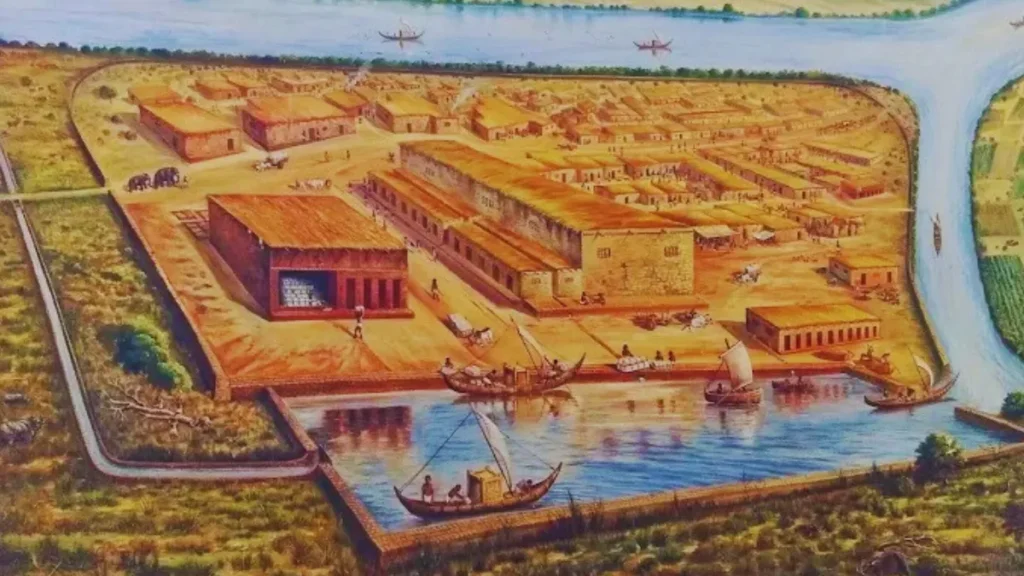
Excavations reveal that the Harappan port city Lothal followed a meticulously laid out quadrangular plan typical of Harappan urban architecture, featuring two distinct zones: the upper town (citadel) and the lower town, each serving specialized roles within the community.
The Upper Town: Nerve Centre of Civic and Administrative Life
Located in the southeast corner of the settlement, the citadel-or upper town-was raised on a mud-brick platform reaching four metres in height. Unlike many other Harappan cities, this elevated complex was not surrounded by a separate fortification wall. Instead, its height provided natural protection from floods and visually distinguished it from the lower town.
Inside the upper town, archaeologists discovered wide streets, well-constructed drainage channels, and neatly aligned bathing platforms-clear indicators of a highly organized civic structure. These features suggest deliberate planning and the presence of administrative or elite residences.
One of the citadel’s most compelling structures is a massive squared platform with partially charred walls. Researchers believe this building functioned as a warehouse, storing valuable goods that bore impressions of Harappan sealings—many likely bundled for export. The presence of charred remains indicates that the structure might have been damaged during a major conflagration or catastrophic flood.
The Lower Town: Industrial Hub and Bead-Making Centre
The lower town reveals a vibrant industrial and commercial landscape. Evidence indicates that Lothal was a major centre for bead-making, a craft for which the Harappans were globally renowned. The discovery of specialized furnaces, raw materials, and unfinished bead pieces highlights the advanced nature of this local industry.
Beads from Lothal have been found in archaeological sites across Mesopotamia and the Persian Gulf, offering clear proof of the city’s role in long-distance international trade.
The proximity of industrial areas to the warehouse and dockyard further illustrates a sophisticated logistical chain-a hallmark of successful port cities in the ancient world.
The Dockyard: A Groundbreaking Maritime Innovation
The single most iconic feature of the Harappan port city Lothal is its massive rectangular basin, widely recognized as the earliest known tidal dockyard in human history. Measuring 217 metres in length and 26 metres in width, this engineering marvel was built with vertical brick walls and a system of inlets and outlets designed to manage water levels during high tide.
A Brilliant Use of Natural Tidal Mechanics
At the northern and southern ends of the basin, Harappan engineers created a sophisticated system of water channels:
- An inlet channel allowed tidal water from the river to flow into the dock.
- An outlet channel enabled controlled drainage and maintained safe water levels for marine operations.
This strategic manipulation of tidal inflow allowed ships to sail upstream from the Gulf of Khambhat during high tide-a sophisticated understanding of maritime physics far ahead of its time.
Stone anchors, marine shells, and seals bearing marks associated with the Persian Gulf reinforce the interpretation of this basin as a fully functional dockyard that supported maritime commerce.
Global Significance and Outstanding Universal Value
Lothal’s extraordinary state of preservation and its immense contribution to our understanding of early trade networks have earned it global admiration. The site stands as the only excavated Indus Valley port town, and its unique archaeological features provide unmatched insights into how Harappan society integrated maritime trade with urban planning.
Satellite imagery and geological studies reveal that in the second millennium BCE, the Bhogava river channel-now completely dried-carried large volumes of tidal water capable of filling the dockyard. This confirms that the dock was not merely symbolic but integral to Lothal’s economic life.
The presence of large warehouses, imported artifacts, and advanced infrastructure demonstrates the settlement’s function as an industrial and trading capital within the Indus civilisation.
Town Planning and Architectural Integrity
The Harappan port city Lothal offers significant physical evidence of hierarchical town planning, technological innovation, and adaptive architecture tailored to a flood-prone environment.
Urban Zones within Fortified Boundaries
Lothal’s landscape consisted of:
- A fortified enclosure containing the upper and lower towns
- A clearly defined industrial sector, including the bead-making workshops
- A vast dockyard, unparalleled among contemporary civilizations
- Residential quarters, showing standard Harappan grid-based planning
Even today, the layout remains discernible, showcasing the settlement’s structural coherence.
Stability Through Conservation
Since its excavation, the Archaeological Survey of India (ASI) has preserved the site with meticulous care, using guidelines established under the Ancient Monuments and Archaeological Sites and Remains Act of 1958 (amended 2010). The site remains in a stable condition, with consolidated walls and visible riverbed deposits showing traces of tidal activity during certain seasons.
Material Evidence Connecting Lothal to Global Trade
Archaeologists have unearthed numerous artifacts at Lothal that trace their origins to far-off regions, notably:
- The Persian Gulf
- Mesopotamia
- Other parts of West Asia
Findings include:
- Stone anchors used in shipping
- Marine shells from distant oceanic waters
- Sealings and seals associated with long-distance trade
- Industrial remains linking Lothal to major export industries such as beads and precious stones
These discoveries confirm Lothal’s position as a thriving industrial port town that played a pivotal role in connecting the Indus Valley Civilisation with international markets.
Authenticity and Cultural Integrity
The authenticity of the Harappan port city Lothal stands reinforced by its preserved architectural framework, artifacts, and the clear continuity between its structures and the broader cultural patterns of the Indus civilization.
Authenticity Indicators
- Presence of both upper and lower town reflecting Harappan socio-economic hierarchy
- Dockyard remains, including inlet and outlet mechanisms
- Evidence of flooding that rendered the port eventually non-functional
- Imported artifacts confirming maritime connectivity
Integrity Indicators
- Settlement built on a dried riverbed, still showing occasional tidal residue
- Clear visibility of original layout
- Stability of excavated remains thanks to ASI conservation
- Preservation of defining features including the dock, warehouse, drainage system, and town grid
These aspects collectively reinforce Lothal’s identity as one of the most authentic archaeological windows into Harappan maritime culture.
Global Comparisons: Lothal and Other Ancient Port Cities
Although Lothal remains unique in many respects, its significance becomes even clearer when compared with other ancient maritime trading centres around the world.
Archaeologists and historians draw parallels between Lothal and several renowned port cities, including:
- Ostia, the ancient port of Rome
- Carthage, the famed North African harbour of Tunis
- Canopus in Egypt
- Xel-Ha in Peru
- Hepu in China
- Jaffa in Israel
- Ur in Mesopotamia
- Hoi An in Vietnam
Within the Indus Valley region itself, comparisons extend to:
- Balakot (Pakistan)
- Khirasa (India)
- Kuntasi (India)
While these settlements share characteristics of maritime trade, none exhibits the combination of a tidal dockyard, industrial manufacturing, and sophisticated flood-resistant architecture as distinctly as Lothal.
Also read: Where Is Lothal? Inside India’s 4,500-Year-Old Port City That Rewrote Maritime History
Why Lothal Matters Today
The story of the Harappan port city Lothal is not simply one of ancient ruins-it is a powerful reminder of how early civilizations adapted to their environment, leveraged natural forces, built global trade networks, and created long-lasting technological solutions.
Lothal serves as:
- A vital educational site for scholars of ancient maritime technology
- A cultural heritage landmark illustrating India’s early global trade connections
- A symbol of sophisticated urban engineering long before modern tools
- Evidence of an interconnected Bronze Age world
With ongoing conservation efforts and renewed global attention, Lothal continues to inform-and inspire-modern generations about the ingenuity and ambition of the Harappan people.
Also read: What Is Lothal: Exploring One of the World’s Earliest Urban Civilisations
Conclusion
The Harappan port city Lothal remains one of the grandest achievements of the ancient Indus Valley Civilisation, offering unparalleled insights into maritime history, urban planning, and long-distance trade. Its vast dockyard, sophisticated drainage systems, industrial workshops, and international trade connections highlight the city’s central role in shaping early global commerce.
As one of the most thoroughly documented sites from the Harappan period, Lothal stands today not just as an archaeological treasure but as a timeless testament to human innovation, adaptability, and cultural depth. Its enduring legacy continues to captivate archaeologists, historians, and travellers from around the world-cementing its place as one of the most valuable heritage sites in human history.