
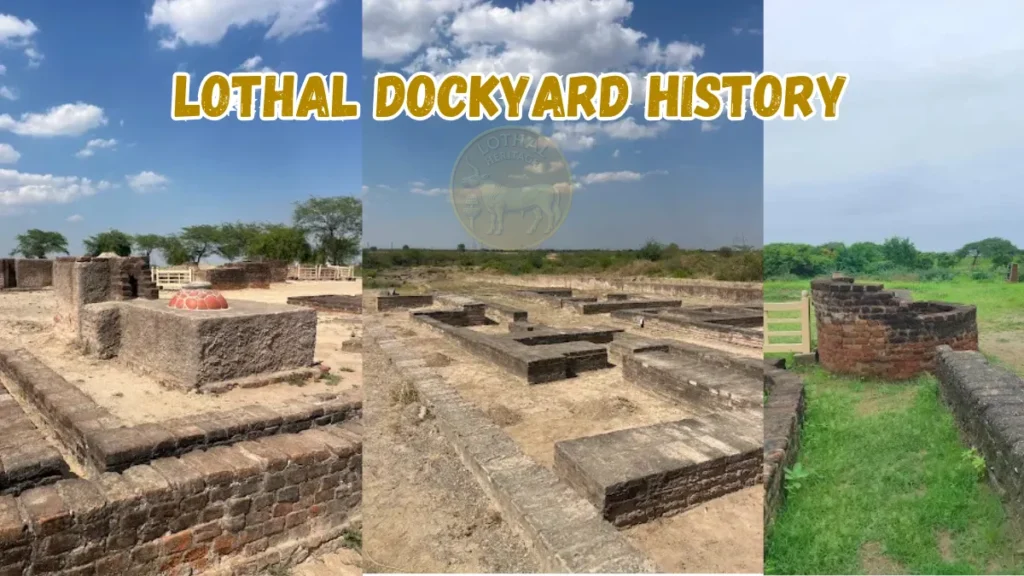
Lothal dockyard history reveals one of the most fascinating achievements of the ancient Indus Valley Civilization, showing how early humans mastered maritime trade, engineering, and urban planning over 4,000 years ago. Located in present-day Gujarat, India, Lothal was not just another Harappan settlement but a thriving port city that connected ancient India with distant civilizations like Mesopotamia, Persia, and the Arabian Peninsula.
The discovery of the dockyard at Lothal changed the understanding of ancient trade and navigation in South Asia. Archaeologists believe that the dockyard was carefully designed to allow ships to enter, dock, and load goods safely. This remarkable structure demonstrates the advanced knowledge of hydraulics, architecture, and city planning possessed by the Indus Valley people.
Today, the history of Lothal dockyard stands as proof that maritime trade and global connections existed thousands of years earlier than many historians once believed.
Location and Discovery of Lothal
Lothal is located in the Bhal region of Gujarat, about 80 kilometers from Ahmedabad. The site lies near the Sabarmati River and was once connected to the Gulf of Khambhat through ancient waterways.
The site was discovered in 1954 by archaeologists from the Archaeological Survey of India. Excavations were carried out between 1955 and 1962 under the leadership of archaeologist S.R. Rao. During these excavations, researchers uncovered a well-planned city that included residential areas, warehouses, streets, drainage systems, bead-making workshops, and the famous dockyard.
The discovery of the dockyard quickly made Lothal one of the most important archaeological sites related to the Indus Valley Civilization. Unlike other Harappan cities such as Harappa and Mohenjo-Daro, Lothal clearly showed evidence of a large maritime trade center.
The city dates back to around 2400 BCE and continued to function as a trading port for several centuries.
The Importance of Lothal Dockyard History in Ancient Maritime Trade
The Lothal dockyard history is extremely important because it represents the earliest known dockyard in the world. It shows that the Indus Valley Civilization was deeply involved in sea trade long before many other ancient societies developed similar maritime infrastructure.
The dockyard allowed ships to anchor safely and facilitated the loading and unloading of goods. Through this port, traders exchanged a wide range of commodities with distant regions.
Some of the main goods traded through Lothal included beads made from semi-precious stones, ivory products, cotton textiles, pottery, shells, and copper items. Archaeological findings also show that Lothal had strong trade connections with Mesopotamia, which is present-day Iraq.
Seals and artifacts discovered at the site indicate that Lothal merchants were actively involved in international trade networks. This demonstrates how advanced the economic system of the Indus Valley Civilization had become.
Structure and Engineering of the Lothal Dockyard
One of the most remarkable aspects of Lothal dockyard history is the sophisticated engineering used in its construction. The dockyard was built using baked bricks and had a rectangular basin that measured approximately 214 meters in length and about 36 meters in width.
The structure was designed to control the flow of water using inlet and outlet channels connected to the nearby river. These channels helped maintain a stable water level inside the dockyard so that ships could dock even during tidal changes.
Archaeologists believe that the engineers of Lothal carefully studied tidal movements before constructing the dockyard. This allowed them to prevent flooding and sediment buildup, which could otherwise block the basin.
The dockyard was connected to a warehouse located nearby. This warehouse was used to store goods that arrived from ships before they were transported to other cities.
This level of urban planning and hydraulic engineering shows the impressive scientific understanding of the Indus Valley people.
Urban Planning Around the Dockyard
Lothal was not just a dockyard but a carefully planned city built around maritime trade. The town was divided into two main parts: the upper town and the lower town.
The upper town served as the administrative and residential area for important officials and traders. The lower town was mainly used for industrial and commercial activities.
Wide streets intersected the city in a grid-like pattern, which was a common feature of Indus Valley cities. Houses were constructed using baked bricks and included proper drainage systems, bathrooms, and wells.
Near the dockyard, archaeologists discovered workshops where artisans produced beads from carnelian, agate, and other semi-precious stones. These beads were among the most valuable export items of Lothal.
The city also had a marketplace where traders could exchange goods before they were transported to ships.
The well-organized layout of Lothal highlights how central the dockyard was to the entire city’s economy.
Trade Connections with Mesopotamia and Other Regions
Another fascinating aspect of Lothal dockyard history is the evidence of international trade links. Archaeologists have found seals and inscriptions similar to those used in Mesopotamia, indicating commercial relations between the two civilizations.
Mesopotamian texts also refer to a place called “Meluhha,” which many historians believe was the Indus Valley region. Ships from Lothal likely carried goods across the Arabian Sea to ports in Oman, Bahrain, and Iraq.
In return, traders brought materials such as metals, precious stones, and luxury items.
This trade network shows that ancient Indian merchants were already participating in a global economy thousands of years ago.
Lothal therefore played a crucial role in connecting South Asia with the rest of the ancient world.
Artifacts Discovered at the Lothal Site
Excavations at Lothal have revealed thousands of artifacts that provide valuable insights into daily life and trade activities.
One of the most famous discoveries is a bead-making factory where craftsmen produced finely polished beads. These beads were made using advanced drilling techniques that required great skill.
Archaeologists also found terracotta figurines, seals, pottery, tools, and ornaments made from copper and bronze. Many of these items show artistic creativity and technical expertise.
Another interesting discovery was a scale used for measuring goods. This indicates that standardized weights and measurements were already in use during that period.
These artifacts demonstrate that Lothal was not only a trading center but also an important manufacturing hub.
Decline of the Lothal Port
Despite its success, Lothal eventually declined due to environmental and geographical changes. Flooding is believed to have damaged large parts of the city several times.
Over time, the river channels that connected Lothal to the sea gradually silted up. This reduced the ability of ships to reach the dockyard, making maritime trade difficult.
As trade routes shifted and environmental conditions worsened, the city slowly lost its importance.
By around 1900 BCE, the Indus Valley Civilization itself began to decline, and many of its cities were abandoned.
Lothal was no exception, and the once-bustling port eventually faded into history.
Archaeological Significance of Lothal Dockyard History
The archaeological importance of Lothal dockyard history cannot be overstated. The site provides rare evidence of ancient maritime infrastructure and highlights the technological achievements of the Indus Valley Civilization.
It also proves that people living in South Asia had developed advanced knowledge of engineering, navigation, and trade long before many other ancient civilizations.
Lothal has helped historians better understand the economic system, trade routes, and daily life of Harappan society.
The discoveries made at this site have contributed greatly to the study of ancient maritime history.
Lothal Museum and Preservation of the Site
Today, the Archaeological Survey of India maintains the Lothal site and its museum. The museum displays many artifacts discovered during the excavations, including beads, seals, pottery, tools, and models of the dockyard.
Visitors can also see reconstructed maps and diagrams that explain how the dockyard functioned.
The site attracts historians, archaeologists, students, and tourists who are interested in learning about one of the world’s earliest port cities.
Efforts are ongoing to preserve the remains of the dockyard and other structures so that future generations can continue to study this important part of human history.
Why Lothal Dockyard History Still Matters Today
Understanding Lothal dockyard history is important because it shows how advanced ancient civilizations were in engineering, trade, and urban planning.
The dockyard demonstrates that global trade networks existed long before the modern era. It also highlights the innovative thinking of ancient Indian engineers who were able to design structures capable of handling tidal movements and maritime traffic.
Studying Lothal helps researchers learn more about early economic systems and cultural exchanges between civilizations.
It also reminds us that India has been an important center of commerce and innovation for thousands of years.
Conclusion
The story of Lothal dockyard history is a remarkable chapter in the history of the Indus Valley Civilization. This ancient port city stands as evidence of the advanced knowledge and capabilities of people who lived more than four millennia ago.
From its carefully engineered dockyard to its thriving trade networks and skilled craftsmanship, Lothal demonstrates the sophistication of early urban societies.
Even today, the remains of the dockyard continue to inspire historians and archaeologists around the world. By studying this incredible site, we gain a deeper understanding of humanity’s early achievements in maritime trade, engineering, and global connections.
Lothal remains one of the greatest archaeological treasures of India and an important symbol of the country’s rich and ancient heritage.