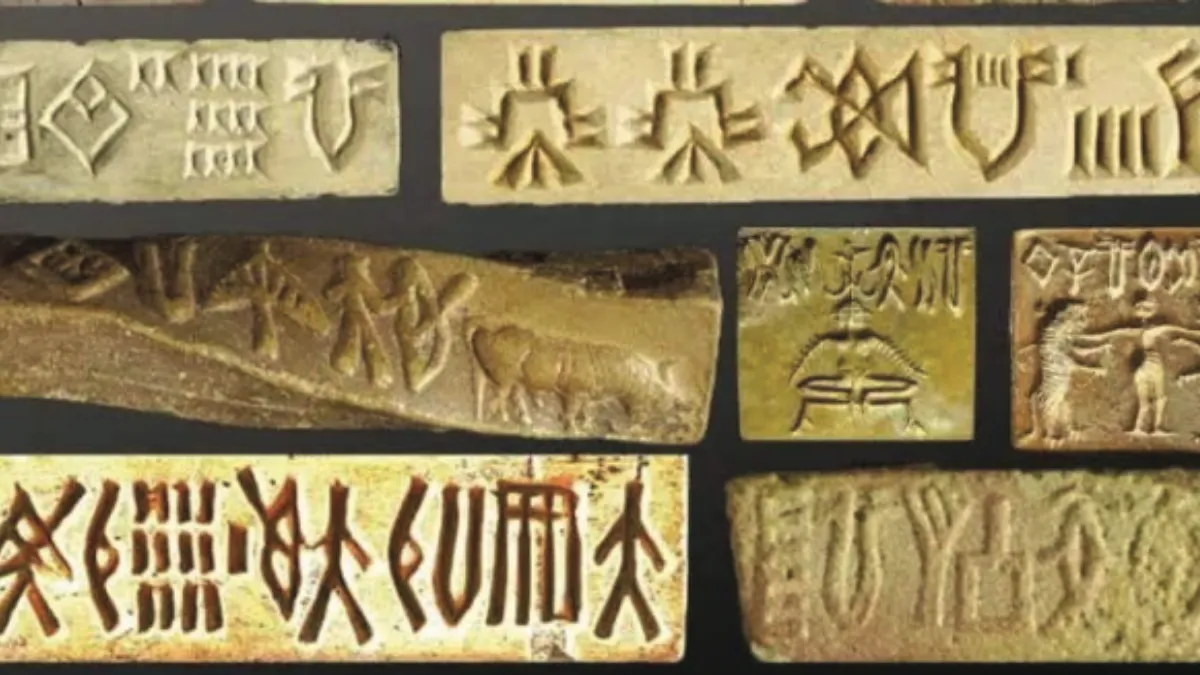
Indus Scrip: For more than a century, scholars across the world have been mesmerised by the mysterious Indus Scrip, an undeciphered writing system developed by the Indus Valley Civilization-one of the world’s earliest, largest and most sophisticated Bronze Age civilisations. The script, discovered on thousands of seals, pottery fragments, tablets, tools, and ornaments, represents the earliest known system of writing in the Indian subcontinent. Yet despite its significance, it remains unreadable, continuing to challenge linguists, archaeologists and historians globally.
The Indus Valley Civilization flourished between 2600 BCE and 1900 BCE, spreading across modern-day Pakistan, northwest India and parts of Afghanistan. It was an urban civilisation marked by advanced drainage systems, standardized weights, monumental granaries, long-distance trade, and remarkable craftsmanship. However, unlike ancient Egypt or Mesopotamia, whose writing systems have long been deciphered, the Indus Scrip has resisted every attempt at interpretation.
Today, as research methods grow more advanced and new archaeological discoveries emerge, global curiosity surrounding the script is intensifying. What language does it record? What messages were engraved on the seals? Why did the system disappear? And how might decoding it reshape our understanding of ancient South Asian history?
This comprehensive article explores the evolution, features, characteristics, challenges and ongoing research surrounding the Indus Scrip-bringing together historical evidence, archaeological insights and the latest academic findings.
Origins of the Indus Scrip: The Birth of a Writing Tradition
The origins of the Indus Scrip can be traced back to the early cultural phases of the Indus region. Archaeologists have documented preliminary signs on pottery and tools dating to approximately 3500–2700 BCE. These early symbols appear mostly as isolated marks-simple strokes, geometric shapes and pictorial figures—likely representing ownership, clan marks, or early proto-writing.
Early Phase (3500–2700 BCE): The Seeds of a Script
Excavations at Harappa have yielded early signs engraved on Ravi and Kot Diji pottery. These inscriptions are brief, often consisting of a single symbol, suggesting a primitive stage of symbol communication rather than a full writing system.
The early Indus marks served as:
- Identification signs used by potters and craftsmen
- Marks indicating trade groups or commodity types
- Proto-symbols that gradually evolved into a standardised writing system
This phase shows the foundation on which the mature Indus Scrip was later built.
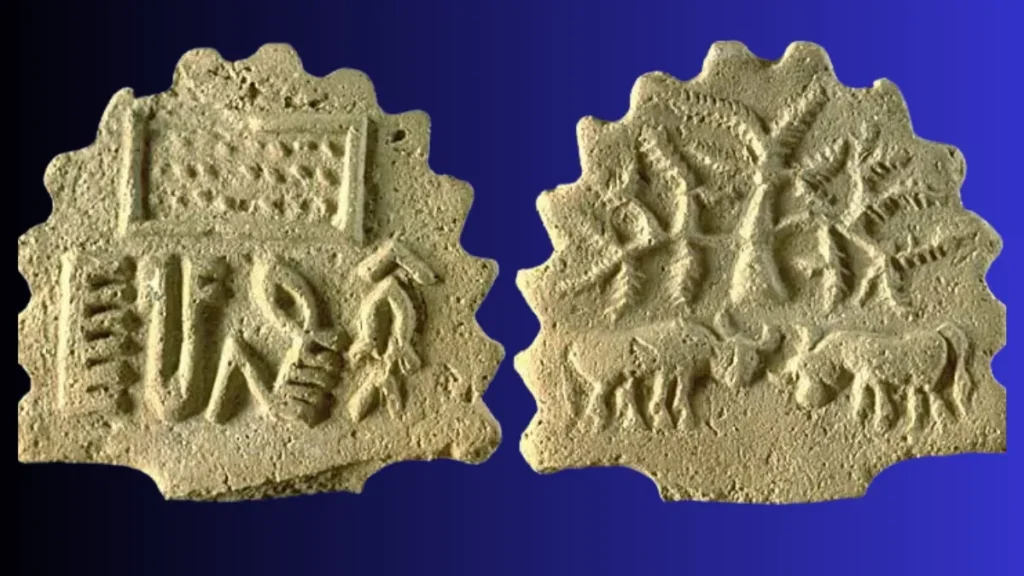
Urban Phase (2600–1900 BCE): The Script Reaches Maturity
The mature phase of the Indus Valley Civilization marks a dramatic transformation. During this period, the Indus Scrip developed into a fully structured system, reflected in thousands of inscriptions discovered across more than 60 archaeological sites.
Key features of this mature phase include:
- Thousands of inscriptions carved on seals, pottery, copper plates, stoneware, ivory, bone, granite and shell objects.
- Average inscription length of 4–6 signs, indicating short, concise writing.
- None of the inscriptions exceed 26 signs, suggesting the script was used for brief taglines, labels, or identifiers rather than long texts or literature.
- Standardised symbols, with structured sign order and precise positioning.
- Widespread diffusion, showing that the writing system was consistently used across the civilization.
The sophistication of the script, combined with standardisation across such a vast region, suggests state-level control or a highly coordinated cultural system.
Features and Structure of the Indus Scrip
The Indus Scrip stands apart due to its unique combination of features derived from both pictorial and abstract symbol traditions. Although undeciphered, researchers have identified structural patterns that reveal the script’s complexity.
Symbol Count and Usage
Approximately 400 basic signs have been catalogued so far. Some scholars estimate the total number might range from 400 to 600, depending on how variants and compound symbols are classified.
Notably:
- Only 31 symbols appear more than 100 times.
- Many signs occur just once, suggesting specialised meanings.
- The limited repetition implies widespread use of perishable materials—such as birch bark, palm leaves or textiles—that have not survived.
Writing Direction: Boustrophedon Format
One of the most distinctive features of the Indus Scrip is its boustrophedon writing style. This means:
- One line is written from right to left,
- The next line may be written from left to right.
This alternating pattern resembles motion used in ploughing fields, a technique also seen in several ancient scripts across the world.
Most Indus inscriptions, especially those found on seals, are written right to left, suggesting this was the primary direction.
Numerical System: A Glimpse into Administrative Precision
The Indus numeral system appears to be based on a decimal pattern:
- Single downward strokes represent units.
- Semicircles are believed to represent tens.
These markings, found on tablets and ceramics, show that the civilization possessed a structured counting system useful for taxation, trade, and administrative record-keeping.
Logo-Syllabic Script
Based on current research, the Indus Scrip is widely believed to be logo-syllabic-a combination of:
- Logographic symbols (representing words or concepts)
- Phonetic syllables (representing sounds)
This structure parallels scripts such as:
- Sumerian cuneiform
- Egyptian hieroglyphs
- Chinese logographs
Such systems allow for both representation of abstract ideas and pronunciation-based writing.
Narrative Imagery: Text Accompanied by Scenes
An intriguing aspect of the Indus Scrip is its association with narrative imagery, where symbols appear alongside:
- Human figures
- Animals such as bulls, tigers, elephants and unicorn-like motifs
- Mythical creatures in dynamic poses
These scenes resemble religious, ceremonial or mythological depictions, pointing toward potential ritualistic or sacred use.
Materials Used for Inscribing the Indus Scrip
The Indus people carved their script across a diverse range of materials, reflecting the economic and cultural richness of the civilization.
Seals: The Most Common Medium
Indus seals are typically:
- Square, often measuring around 2.54 cm²
- Made of steatite, later fired to create a glossy surface
- Engraved with script at the top
- Decorated with animal motifs at the centre
Occasionally, seals were made from silver, faience, bronze or calcite, indicating variation in economic or symbolic value.
Functions of seals included:
- Labeling trade goods
- Marking ownership
- Identifying officials or merchants
- Possibly serving as amulets or talismans
Indus seal impressions found in Mesopotamia show that long-distance trade routes connected the Indus region with ancient Sumer.
Other Materials
The script has been found on:
- Pottery
- Bronze tools
- Bone objects
- Shells
- Ivory pieces
- Stoneware bangles
- Copper tablets
This diversity suggests widespread everyday use.
Challenges in Deciphering the Indus Scrip
Despite over a century of research, the Indus Scrip remains one of the world’s most enigmatic writing systems. Several major obstacles hinder decipherment.
1. Lack of Bilingual Texts
Languages like ancient Egyptian were deciphered thanks to the Rosetta Stone, which provided the same text in three scripts.
No such bilingual inscription exists for the Indus Scrip.
2. Short Length of Inscriptions
Most inscriptions contain fewer than 10 signs. None exceed 26 signs.
This brevity makes it nearly impossible to:
- Identify syntax
- Detect grammar
- Establish recurring structural patterns
3. Unknown Underlying Language
Scholars have proposed multiple language families:
- Proto-Dravidian
- Indo-European
- Austroasiatic
- A long-lost linguistic family
Without consensus on the base language, decipherment remains stalled.
4. No Clear Link to Later Indian Scripts
Unlike Mesopotamian scripts that evolved gradually, the Indus Scrip seems to vanish after 1900 BCE. Later writing systems such as Brahmi show no clear connection.
This discontinuity further complicates comparative analysis.
Recent Discoveries and New Research Directions
Modern excavations and analytical techniques have opened new avenues in understanding the Indus Scrip.
Tamil Nadu Graffiti Findings: Possible Dravidian Links
Recent discoveries in Tamil Nadu-particularly at Sivakalai and Keezhadi-yielded over 10,000 graffiti marks dating between:
- 2500–3000 BCE at Sivakalai
- 580 BCE at Keezhadi
These symbols show marked similarities to Indus signs.
A study published in Palgrave Communications (Nature group) suggests:
- Indus inscriptions were primarily logographic
- The signs likely conveyed meaning through symbols rather than phonetic writing
- The earlier belief in rebus methods (using picture signs for sound values) may be incorrect
- Seals were used mostly for administrative and commercial functions, not for recording personal names
This strengthens the theory that the Indus Scrip may represent an early Dravidian language.
Rejection of Proto-Dravidian Name Hypothesis
The common assumption that seal inscriptions contain the owner’s name has been challenged.
Researchers now believe:
- The seals more likely represented institutional, religious or administrative identifiers
- The writing was not personalised but systematic
This changes how experts interpret the function of the script.
Decline of the Indus Scrip
Around 1800 BCE, the Indus Valley Civilization began to decline due to a combination of environmental stress, river course shifts, and urban decentralisation.
With this decline:
- The Indus Scrip sharply reduced in usage
- Only crude graffiti-like forms survived into the post-urban phase
- The later Vedic culture did not adopt the script, nor did it appear to have a writing system until much later
Thus the Indus Scrip vanished completely, leaving behind an unresolved historical mystery.
Also read: Lothal Uncovering India’s Earliest Maritime Legacy and the Dockyard of Harappan Civilization
Why Deciphering the Indus Scrip Matters Today
Understanding the Indus Scrip is more than a linguistic curiosity-it holds the key to unlocking deeper truths about one of humanity’s earliest civilisations.
Decipherment would reveal:
- The social and political organisation of the Indus people
- Their religious beliefs and mythologies
- Their administrative and economic systems
- Their technological advancements
- Their interactions with neighbouring cultures
In short, decoding the Indus Scrip could rewrite global history by illuminating a civilization more advanced than most of its contemporaries.
Also read: Town Planning of Harappan Civilization: A Remarkable Legacy of Urban Vision
Global Efforts and the Road Ahead
Today, deciphering the Indus Scrip is a multidisciplinary challenge. Researchers from linguistics, AI modelling, archaeology, statistics, and epigraphy collaborate on new methods.
Modern Approaches Include:
- AI-based pattern recognition to identify symbol sequences
- Statistical linguistics to test grammar structures
- Computational comparisons with global scripts
- Archaeological surveys to discover new inscriptions
- Material analysis to understand usage context
Although a definitive breakthrough remains elusive, each year brings new insights.
Conclusion: The Indus Scrip-A Silent Witness Waiting to Speak
The Indus Scrip stands today as one of the world’s last great undeciphered writing systems. It is more than a series of ancient signs-it is the voice of a civilisation that mastered urban planning, international trade, and cultural expression long before many others.
As global research intensifies, the Indus Scrip continues to attract scholars, linguists, historians and enthusiasts. Its resolution could transform our understanding of ancient South Asia and reshape narratives of early human civilisation.
Until then, those etched symbols on ancient seals and tablets remain a silent but powerful reminder of an extraordinary culture-waiting patiently for the day its language is finally understood.
Indus Scrip – Frequently Asked Questions (FAQs)
What is the Indus Scrip?
The Indus Scrip refers to the symbolic writing system used by the Indus Valley Civilization between 2600 and 1900 BCE. These symbols appear on seals, pottery, terracotta tablets, tools, jewellery ornaments and copper plates. The inscriptions are typically very short and combine both pictorial figures and abstract geometric signs. Although thousands of examples have been discovered across modern-day Pakistan and northwest India, the Indus Scrip remains undeciphered, making it one of the world’s most intriguing ancient writing systems.
What is the longest Indus Scrip inscription?
The longest known Indus Scrip inscription contains 26 signs, found on a copper plate discovered at the site of Mohenjo-Daro. Most inscriptions are extremely short—usually between four and six signs—which is one of the reasons deciphering the script has remained so difficult. The absence of long texts, such as those found in Egyptian or Mesopotamian writing, prevents researchers from identifying grammar or sentence structure.
Is the Indus Valley Script Sanskrit?
No. There is no evidence that the Indus Scrip represents Sanskrit. Sanskrit belongs to the Indo-European language family and appears much later in the historical timeline, associated with the Vedic period. The Indus Scrip predates Vedic culture by centuries. While some scholars have proposed a possible connection with early Dravidian languages, others suggest it may encode an entirely lost linguistic family. Until the script is decoded, the exact language behind it remains unknown.
Why is deciphering the Indus Scrip important?
Deciphering the Indus Scrip would open a window into one of the world’s most advanced ancient civilisations. It would help scholars uncover:
The political and administrative systems of the Indus cities
Their religious beliefs, rituals and mythologies
Trade practices, economic networks and social organisation
Names of rulers, cities, professions or deities
Connections between the Indus region and neighbouring ancient cultures
Understanding the script would significantly reshape world history and clarify the linguistic roots of the Indian subcontinent.