
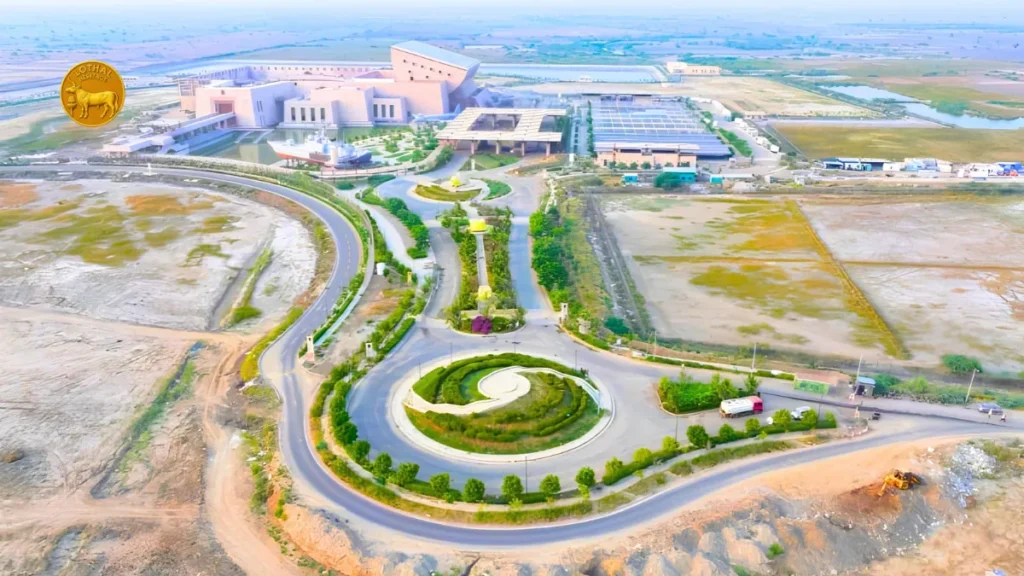
Gujarat is getting ready to add a major attraction to its tourism map. The ambitious Lothal Maritime Heritage Complex is nearing completion of its first phase and is expected to open its doors to visitors soon. Spread across approximately 400 acres, the project is being developed with an estimated investment of Rs 4,500 crore.
Located around 80 kilometres from Ahmedabad, the complex aims to bring India’s ancient maritime history closer to people while creating new opportunities for tourism, research and local businesses.
The Gujarat government is also looking to attract private investment in hospitality, recreation, eco-tourism and other related sectors ahead of the Vibrant Gujarat Global Summit 2027.
Why Is the Lothal Maritime Heritage Complex Being Developed?
Lothal holds an important place in India’s ancient history. It was one of the significant trading and maritime centres associated with the Indus Valley Civilisation.
Thousands of years ago, the ancient settlement was connected with maritime trade and commercial activities. Its archaeological remains continue to offer valuable insights into how people lived, traded and managed their port facilities during that period.
The National Maritime Heritage Complex (NMHC) is being developed to showcase this rich history. Its main objective is to present India’s approximately 5,000-year-old maritime journey, connecting ancient trading traditions with the country’s modern ports and maritime development.
The project is being developed by the Union Ministry of Ports, Shipping and Waterways under the Sagarmala Programme. It is planned in multiple phases, combining historical exhibitions with modern technology, educational activities and recreational facilities.
First Phase to Feature 14 Galleries on India’s Maritime History
Work on Phase 1A is progressing rapidly, and the facility is expected to welcome visitors soon.
One of the major highlights will be 14 galleries presenting different chapters of India’s maritime history. Visitors will get an opportunity to explore the country’s journey from the seafaring traditions of the Indus Valley Civilisation to the development of the modern Indian Navy and Coast Guard.
These galleries are expected to make the experience interesting for tourists, students, history enthusiasts and researchers.
Rather than simply displaying historical objects, the complex aims to explain how India’s maritime activities, trading networks and naval capabilities developed over thousands of years.
77-Metre-High Lighthouse Museum to Become a Major Attraction
Among the most talked-about features of the project is a massive 77-metre-high lighthouse museum.
The structure is being developed at an estimated cost of Rs 200 crore and is described as the world’s tallest lighthouse museum.
It is expected to become one of the major attractions within the complex, offering visitors an opportunity to learn about the history and importance of lighthouses and maritime navigation.
Another interesting feature will be a recreation of an ancient Harappan town, including a replica of what is described as the world’s oldest dockyard.
This attraction will help visitors understand how ancient communities managed port infrastructure, organised maritime trade and connected with other regions through sea routes.
Four Theme Parks and an Underwater Gallery Planned
The Lothal Maritime Heritage Complex will not be limited to museums and historical exhibitions. The project also includes several entertainment and recreational attractions designed to make it a destination for families and tourists.
Some of the planned facilities include:
- Four different theme parks
- An underwater gallery
- Eco-resorts
- Water rides and recreational activities
- Marine recreation centres
- Coastal State Pavilions showcasing India’s coastal culture
The Coastal State Pavilions will highlight the traditional art, culture and heritage of different coastal states across India.
These attractions are expected to give visitors a combination of historical learning, cultural experiences and entertainment.
India Signs MoUs With 13 Countries for International Collaboration
The project has also received international attention through partnerships with several countries.
According to the project details, 13 memoranda of understanding (MoUs) have been signed with Portugal, Vietnam, the United Arab Emirates, Thailand, Oman, South Korea, Italy, the Netherlands, Israel, Germany, Denmark, New Zealand and Singapore.
These agreements are intended to encourage knowledge sharing and international cooperation, particularly in museum development, historical presentation and maritime heritage.
The project has set a target of signing a total of 35 MoUs, creating opportunities for further international collaboration.
New Employment and Business Opportunities for Local Communities
The development of such a large tourism destination is also expected to benefit people living in and around Lothal.
As visitor numbers increase, demand for hotels, restaurants, transportation, local products and tourism-related services could create new business opportunities.
Local artisans, small traders and cottage industries may also benefit from the arrival of domestic and international tourists.
According to project estimates, the complex is expected to generate thousands of direct and indirect employment opportunities.
This could provide additional income opportunities for nearby communities and encourage the growth of small businesses connected with tourism.
Also read: Lothal Gujarat: Exploring One of India’s Earliest Urban Civilizations
Eco-Friendly Transport and Maritime Research Institute Planned
Environmental considerations are also part of the project’s development plan.
The National Maritime Heritage Complex is being planned as India’s first heritage tourism destination to operate entirely through an eco-friendly transport system.
Another important proposal is the establishment of a Maritime Research Institute within the complex.
The institute is expected to support research, specialised training and the development of expertise in the maritime sector.
Together, the research facilities, historical galleries and recreational attractions are intended to make the complex useful for tourists as well as students and researchers.
Also read: Harappan Port City Lothal: Unearthing the Legacy of the World’s Earliest Known Tidal Dockyard
Vibrant Gujarat Summit 2027 May Bring More Investment Opportunities
With the first phase approaching completion, the project is also becoming an important part of Gujarat’s broader tourism and investment plans.
Ahead of the Vibrant Gujarat Global Summit scheduled for January 2027, the state is looking to highlight investment opportunities connected with the complex.
Hospitality, hotels, eco-tourism, entertainment, local handicrafts and tourism services are among the sectors that could attract private investors.
The development is expected to strengthen Lothal’s position as a heritage tourism destination while creating new economic opportunities in the surrounding region.
Lothal Could Get a New Identity on Gujarat’s Tourism Map
For years, Lothal has been recognised as an important archaeological site connected with the Indus Valley Civilisation. The development of the Lothal Maritime Heritage Complex is expected to add a new dimension to this historic destination.
By bringing together ancient history, modern exhibitions, research facilities and recreational attractions, the project aims to offer visitors a different way to explore India’s maritime past.
Once the first phase opens to the public, Lothal could become an important destination for families, history lovers, students and international tourists.
However, visitors should wait for an official announcement regarding the opening date before planning their trip.
Also read: What Is Lothal: Exploring One of the World’s Earliest Urban Civilisations